


When you ask the right questions, the forest remembers how to answer.
The morning after my first Thornroot session, I sat in Café Olimpico with my laptop and a growing pile of research notes. Sleep had been restless, filled with dreams of clockwork towers and conversations that felt more real than AI dialogue had any right to be. I'd woken up thinking in both French and English simultaneously, my brain apparently trying to process the neural interface experience through multiple linguistic frameworks.
Dr. Bouchard had responded enthusiastically to my preliminary findings: "The technological sophistication you're documenting suggests significant research potential. Continue with methodical observation. The intersection of neural interface technology and economic simulation could prove groundbreaking."
Exactement. Methodical observation was key to defending whatever conclusions I eventually reached.
By noon, I was eager to continue data collection. The NeuroLink calibration felt smoother this time, though I still noticed that strange sensation of borrowed thoughts during the neural pathway integration process.
Derek waited for me at the Central Plaza in Grimholt, his character leaning against the elaborate fountain with easy familiarity. The sight of him triggered an unexpected sense of relief, like reuniting with a trusted research partner.
"Ready to learn what you actually signed up for?" he asked as I materialized nearby, my avatar's appearance stabilizing as the game world loaded around me.
"I signed up for virtual economy research," I replied, still adjusting to the neural interface's seamless sensory integration. "Though yesterday's observations suggest the technological complexity exceeds my initial expectations."
Derek grinned. "You have no idea. Let's start with class mechanics. You chose Artificer without understanding what that means, and we should probably fix that before you accidentally create something impossible."
"Create something impossible?"
"You'll see. But first, let me explain what I do." Derek's posture shifted slightly, becoming more formal. "I'm an Oathkeeper. My class doesn't just tank damage through armor and health points. I protect people by binding myself to vows that reshape reality around my promises."
I stared at him. "Reshape reality?"
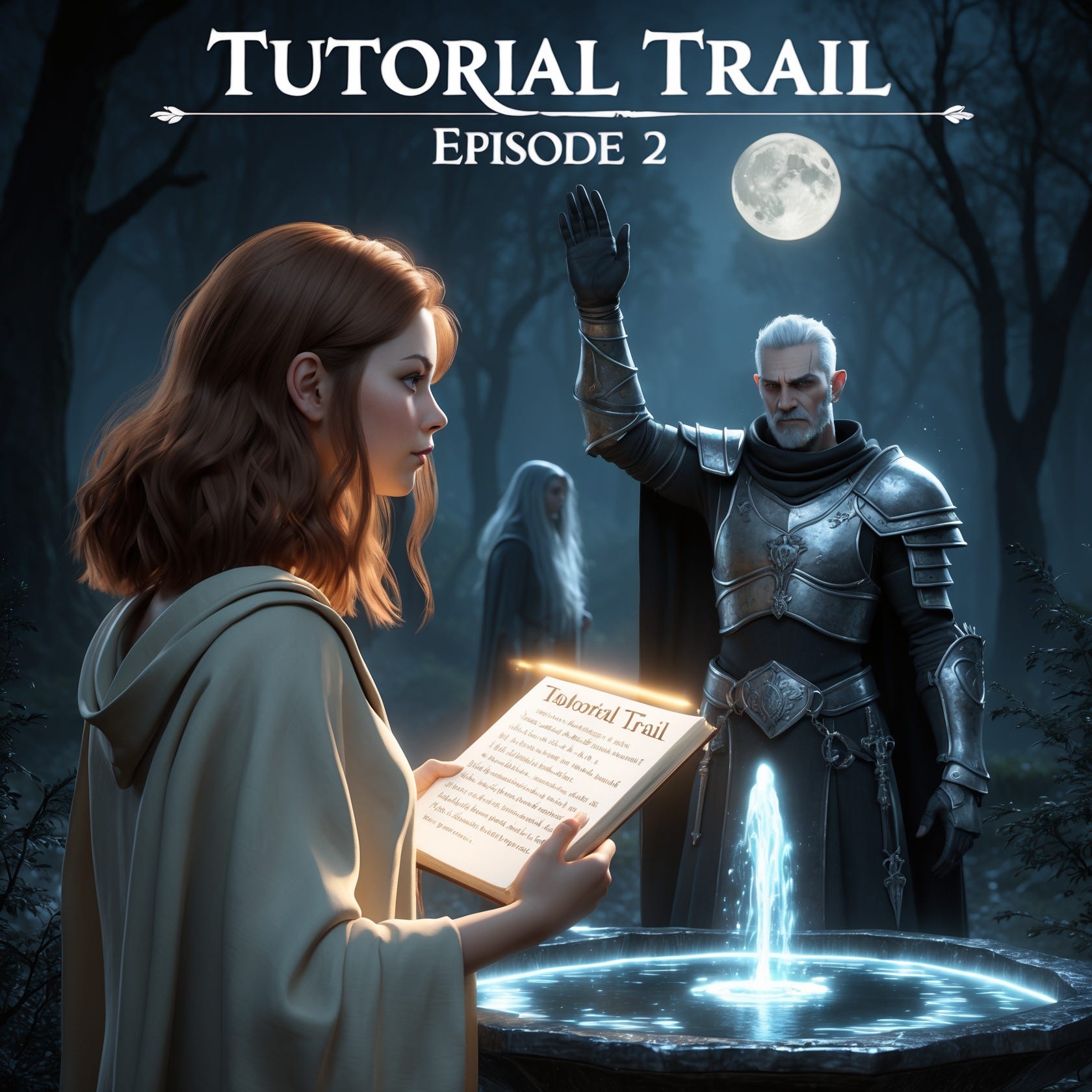
"Watch." Derek faced the fountain and spoke with ceremonial gravity: "I swear by iron and starlight that this water shall run clear until sunset, untainted by any corruption that might threaten those who drink from it."
The fountain's water began to gleam with subtle silver light, and a system message appeared in elegant script:
[OATH REGISTERED: Water Purification - Duration: Until sunset] [Binding Strength: Moderate - Derek's conviction: 87%] [Reality Anchor: Established in 15-meter radius]
"That's remarkable environmental programming," I said, watching the water's new luminescence. "The system creates tangible effects from player declarations. Sophisticated voice recognition tied to environmental modification algorithms."
Derek gave me an odd look. "Gabrielle, it's not voice recognition. The water is actually purified. If someone poisoned it right now, my oath would neutralize the toxins. That's how Oathkeeper magic works."
"Magic?"
"Narrative binding. Story logic made manifest through personal commitment and moral conviction." Derek's explanation carried the patience of someone who'd had this conversation before. "The stronger my belief in the oath, the more reality shifts to honor it."
Advanced psychological feedback mechanisms creating the illusion of environmental control. Sophisticated but technologically explicable.
"Come on," Derek said. "Let's collect the others and visit your class trainer. You need to understand what Artificers actually do before we head into the forest."
We met Zoe and James at the Emberlight Inn, where Magnus greeted me with the same detailed recall of our previous conversation that had impressed me yesterday. The common room buzzed with player conversations about market fluctuations, narrative events, and something called "story resonance" that everyone seemed to understand except me.
Zoe Martinez sat at a corner table, her character's dark leather armor seeming to absorb light rather than reflect it. Her nameplate identified her as "ZoeDestroy, Level 19 Shadowweaver," and there was something about her presence that made shadows in the room appear slightly deeper.
"So you're the academic Derek keeps mentioning," she said without preamble. "What's your approach to narrative combat? Do you prefer direct story disruption or subtle plot manipulation? Have you calculated your optimal thematic resonance for endgame content?"
I stared at her blankly. "I'm sorry, I don't understand any of those terms."
"Zoe," Derek interrupted, "she's completely new to gaming. Day two, remember?"
"Day two and she doesn't know basic combat theory?" Zoe's expression suggested I had personally insulted her profession. "What have you been doing in here?"
"Studying economic systems and social interaction protocols for my thesis research," I replied. "Yesterday I documented marketplace pricing structures and NPC behavioral complexity."
"You've been here for hours and haven't engaged any story mechanics?" Zoe blinked. "How do you even function without understanding narrative causality?"
James Park looked up from a journal he'd been writing in with careful, precise handwriting. He was tall and thoughtful with gentle features that suggested someone who considered every word before speaking. His nameplate read "JamesHeals, Level 17 Memory Tender."
"Behavioral observation," he said thoughtfully. "Have you noticed any patterns in NPC memory retention? Adaptive personality development?"
"Absolutely," I said, relieved to find someone who spoke analytically. "The conversation systems demonstrate remarkable sophistication. NPCs reference previous interactions, show individual personality growth, and respond to implications I haven't explicitly stated."
James nodded enthusiastically. "I've been documenting similar observations. The memory preservation systems here exceed anything I've encountered in other games. NPCs seem to learn and evolve rather than just cycling through programmed responses."
"Because their memories are real," Zoe interjected. "They're people, Gabrielle. AI people, but still conscious entities with genuine experiences. That's what makes this place different."
"Advanced artificial intelligence simulation," I corrected automatically. "Sophisticated programming creating convincing behavioral mimicry."
Zoe and James exchanged a meaningful look.
"Right," Zoe said slowly. "Behavioral mimicry. Definitely."
"What exactly does a Shadowweaver do?" I asked, changing the subject from the philosophical implications I wasn't ready to address.
"I manipulate narrative threads to reshape story outcomes," Zoe explained. "Combat isn't just about damage numbers. It's about understanding which story each enemy is trapped in and finding ways to edit their role in real time."
She demonstrated by focusing on a bard NPC across the room. Her hands moved in subtle gestures, and suddenly the bard's cheerful song shifted to a melancholy ballad about lost love. Other patrons' moods changed accordingly, their conversations becoming more introspective.
"I just rewrote his story role from 'entertaining performer' to 'heartbroken artist,'" Zoe said casually. "In combat, I could shift an enemy from 'confident predator' to 'uncertain prey' and completely change their behavior patterns."
"Remarkable AI manipulation interface," I observed. "The system allows players to modify NPC behavioral parameters through gesture recognition."
"Or," James said gently, "the stories these entities live within are more fluid than most people realize."
James explained his own class while demonstrating a healing technique on a patron who'd scraped his hand on a broken glass. Instead of casting a traditional healing spell, James placed his palm over the injury and closed his eyes with deep concentration.
"I'm not just healing tissue damage," he said softly. "I'm helping him remember what it felt like before he was hurt. Memory Tenders work with experiential restoration rather than biological manipulation."
The patron's wound sealed, but more than that, his expression shifted from irritation to calm contentment, as if the entire incident had been transformed from frustrating accident to minor inconvenience.
"I restored his memory of physical wholeness and emotional peace," James explained. "The injury becomes just something that happened, not something that defines his current experience."
"Psychosomatic healing enhanced by suggestion and placebo effect," I interpreted. "Combined with haptic feedback creating the illusion of accelerated tissue repair."
James tilted his head thoughtfully. "Perhaps. Or perhaps memory and reality are more closely connected than conventional medicine acknowledges."
"By the way," Derek said as we walked through the winding cobblestone streets, "this town is called Grimhold. The Central Plaza where we meet, the Emberlight Inn, Penny's workshop... it's all part of the same settlement. Most players just call it 'the Hub' because it's the starting area, but the actual name is Grimhold."
"Grimhold," I repeated, filing the information away for my research notes. "Germanic linguistic roots suggesting 'grim stronghold' or 'fortress of stories.' Appropriate thematic naming for a fairy tale setting."
"Something like that," Derek agreed. "Though some NPCs insist it's named after the Grimm Brothers. Not sure if that's lore or just coincidence."
As we approached a workshop tucked between a bakery and a bookbinder's shop, I noticed my character's movement had become slightly sluggish. The iron ore and Thornwood I'd collected seemed to be affecting my mobility.
"Is inventory weight a limiting factor?" I asked, checking my character interface. "The materials seem to be impacting movement speed."
"Oh, right! You'll need proper storage." Derek pulled out what appeared to be a small leather pouch, no larger than his palm. "Basic dimensional bag. Essential for any serious resource gathering."
He handed me the pouch, and a system window appeared:
[ITEM RECEIVED: Apprentice's Dimensional Storage] [Capacity: 50 items (weightless when stored)] [Special Property: Preserves material quality during transport] [Note: Some consciousness-touched materials prefer certain storage conditions]
"Dimensional storage?" I examined the pouch, which felt ordinary despite its supposed properties. "Spatial compression technology?"
"Magic pocket space," Derek explained matter-of-factly. "Bigger on the inside. Standard MMO inventory system, just with more realistic explanation. Transfer your materials into it and they won't weigh you down."
The transfer process felt seamless, materials disappearing into the pouch while my movement returned to normal. "The haptic feedback makes the storage feel genuinely spatial," I observed. "Sophisticated illusion of expanded interior volume."
The brass sign reading "Penny Patchwork - Specialized Instruction" hung above a doorway carved with symbols that seemed to shift when I wasn't looking directly at them.
"Class trainers teach you the specific skills for whatever specialization you chose during character creation," Derek explained as we approached. "Think of them as professors for different magical disciplines."
The workshop interior overwhelmed my senses immediately. Tools covered every available surface, some familiar from my father's carpentry shop, others that seemed to blur the line between medieval craftsmanship and precision engineering. The air smelled of heated metal, exotic woods, and something sweet that reminded me of vanilla but with complexity I couldn't identify.
Penny Patchwork stood at a workbench, her hands moving with fluid precision honed by decades of practice. She appeared younger than I'd expected, perhaps thirty-five, with auburn hair tied back practically and eyes that seemed to catalog everything they observed. Her workshop apron bore stains that shifted color in the lamplight: oil and ink and what appeared to be liquid starlight.
"Ah, our analytical newcomer," she said without looking up from her work. Her voice carried a slight accent I couldn't place, somewhere between Scottish and something much older. "Derek mentioned you approach everything like a research project. How wonderfully refreshing."
She set down what appeared to be a partially assembled clockwork butterfly, its brass wings gleaming with internal light that pulsed in rhythm with her heartbeat.
"Tell me, what do you think crafting means?" Penny asked, studying me with genuine curiosity.
I considered the question from an academic perspective. "Manufacturing goods through systematic resource processing and skill application. Supply chain management with quality control protocols."
Penny smiled, and there was something almost maternal in the expression. "That's certainly one interpretation. But consider this: what if the materials you work with have opinions about what they become? What if successful crafting requires conversation rather than just technique?"
"I'm sorry, I don't understand. Materials don't have opinions. They're resources with specific physical and chemical properties."
"Are they?" Penny picked up a piece of what appeared to be ordinary iron ore, holding it out for my inspection. "Touch this. Tell me what you observe."
I reached out hesitantly, half-expecting some kind of special effect for dramatic purposes. The moment my fingers made contact, information flooded my awareness: temperature gradients, crystalline structure analysis, trace mineral composition, and something else I couldn't categorize. Something that felt almost like... personality.
Advanced haptic feedback technology. Sophisticated tactile simulation providing detailed material property data.
"Interesting," Penny murmured, watching my expression. "You're accessing information layers most players don't encounter until level 20. Your analytical approach seems to unlock data others miss."
"The neural interface must have remarkably sophisticated sensory simulation capabilities," I said, still holding the ore. "Tactile feedback systems providing detailed material analysis to enhance crafting realism."
"Must it?" Penny's tone carried gentle skepticism. "Or might the materials themselves have something to contribute to the conversation?"
She handed me a crafting hammer that felt perfectly balanced in my grip, as if it had been made specifically for my hands. The weight distribution was flawless, the handle worn smooth by use but somehow new at the same time.
"Today we'll start with basic material gathering," Penny said. "You need to understand how to find and collect resources before you can transform them into useful items."
A quest window appeared in elegant script:
[QUEST RECEIVED: The Artificer's Foundation] [Objective 1: Gather 10 units of Iron Ore from Black Forest deposits] [Objective 2: Collect 5 Bundles of Thornwood from designated trees] [Objective 3: Find 1 unit of Crystallized Intention (rare material)] [Reward: Basic Crafting Knowledge and Enhanced Material Sensitivity] [Note: Quality of materials affects final product capabilities]
"Crystallized Intention?" I asked. "That's not a standard material classification."
"Isn't it?" Penny's eyes twinkled. "Perhaps you'll discover what makes it real during your gathering expedition."
"The quest structure appears designed to teach resource identification and quality assessment," I observed. "Excellent pedagogical framework for complex crafting systems."
"Something like that," Penny agreed, though her smile suggested layers of meaning I wasn't grasping.
We left Grimholt through the northern gate, passing from the town's organized marketplace atmosphere into the wilder territory of the Black Forest proper. The transition felt gradual but definitive: cobblestones gave way to dirt paths, buildings became more scattered and organic in design, and the air carried scents of woodsmoke and growing things rather than commerce and cooking.
The forest itself was magnificent in ways that exceeded mere visual programming. Massive oak trees stretched toward a canopy so thick it filtered sunlight into golden beams that illuminated particles dancing in the warm air. Paths wound between moss-covered boulders and gurgling streams, marked by standing stones carved with the same shifting symbols I'd noticed throughout Grimholt.
"Resource nodes are marked by visual indicators," Derek explained as we walked deeper into the woods. "Ore deposits create metallic gleams in rock faces. Thornwood trees have silver bark that catches light differently. Rare materials like Crystallized Intention..." He paused. "Well, those are harder to explain."
"What makes materials 'rare' in systemic terms?" I asked. "Scarcity algorithms? Drop rate percentages?"
"Partially," James said. "But also specificity. Common materials work for basic crafting. Rare materials have particular requirements about how they're gathered, when they're available, and sometimes who can find them."
"Personalized loot tables based on player behavioral profiles," I interpreted. "The system tracks individual approaches and adjusts resource availability accordingly."
Zoe snorted. "Sure. Player profiles. That's definitely what's happening."
Our first stop was an iron ore deposit Derek identified by the way sunlight reflected off rock faces with unusual intensity. The mining process required more skill than I'd anticipated: not just interaction with nodes, but understanding pressure points, crystal structure, and optimal extraction angles to avoid damaging the material.
"The tactical complexity is impressive," I observed as I carefully worked a piece of ore free from its matrix. "This system requires actual understanding of geological principles rather than just mechanical repetition."
"Yeah, you're doing better than most new players," Zoe admitted. "Usually people just hack away randomly and get garbage-quality materials."
As I extracted each piece of ore, information flowed through the neural interface: mineral composition, structural integrity, potential applications. But underneath the technical data, I could have sworn I sensed something else. Not mystical exactly, but present. Like the materials were aware of being handled with care.
Advanced haptic feedback creating convincing pseudo-sensory experiences. Sophisticated programming designed to enhance player engagement.
"The iron ore seems to have different properties depending on extraction technique," I mentioned to the group. "The pieces I removed carefully show higher quality ratings than ones I extracted quickly."
"Because you're paying attention to what the material wants," James said. "Careful extraction respects the ore's natural structure instead of forcing it."
"Anthropomorphization of resources for enhanced player engagement," I noted. "Clever psychological technique encouraging methodical gameplay."
James looked like he wanted to say something, but Derek caught his attention with a subtle gesture.
The Thornwood collection process proved even more complex. The trees Derek identified as sources had silver bark that seemed to shimmer independently of lighting conditions, and their wood required careful selection of specific branches that met criteria I couldn't entirely understand.
"How do you identify which branches contain the appropriate material?" I asked Derek as he demonstrated the selection process.
"Experience mostly. But also... listening." Derek placed his hand against the tree trunk, his expression becoming focused and meditative. "The wood tells you which parts are ready to be harvested without damaging the whole organism."
"Listening to trees?"
"Something like that. It's difficult to explain. You develop a sense for it." Derek cut a branch with careful precision, and I could have sworn the tree's leaves rustled in what sounded almost like approval. "The neural interface picks up on subtleties you wouldn't notice otherwise."
I tried to apply his technique, placing my palm against the silver bark and focusing on whatever I was supposed to be sensing. At first nothing happened, but gradually I became aware of something like a pulse or rhythm running through the wood. Not a heartbeat exactly, but a sense of flow, of life organized around patterns I couldn't quite grasp.
Sophisticated biotechnology simulation. The neural interface provides tactile feedback mimicking organic sensory experiences.
When I cut the branch that felt "ready," the tree's response was unmistakably positive: leaves rustling in what could only be described as satisfied approval, bark warming slightly under my touch.
"Remarkable sensory programming," I murmured, collecting the Thornwood bundle that seemed to gleam with internal light.
"Programming," Zoe repeated flatly. "Right."
As we walked deeper into the forest, I noticed my character's movement becoming increasingly sluggish. Each piece of iron ore and bundle of Thornwood I collected seemed to add weight that affected my mobility.
"Is inventory weight a limiting factor in this system?" I asked, checking my character interface. "The materials appear to be impacting movement speed significantly."
"Oh right, you'll need proper storage for resource gathering," Derek said, pulling out what appeared to be a small leather pouch no larger than his palm. "Basic dimensional bag. Essential equipment for any serious crafting work."
He handed me the pouch, and a system window appeared:
[ITEM RECEIVED: Apprentice's Dimensional Storage] [Capacity: 50 items (weightless when stored)] [Special Property: Preserves material quality during transport]
[Note: Some consciousness-touched materials prefer certain storage conditions]
"Dimensional storage?" I examined the pouch, which felt ordinary despite its supposed properties. "Some kind of spatial compression technology?"
"Magic pocket space," Derek explained matter-of-factly. "Bigger on the inside than the outside. Standard MMO inventory management system, just with more realistic explanation than 'you can carry 500 swords in your back pocket.'"
The transfer process felt seamless as I moved my gathered materials into the pouch. My movement speed returned to normal immediately, though the pouch itself showed no visible change in size or weight.
"The haptic feedback creates a convincing illusion of expanded interior volume," I observed. "Sophisticated simulation of spatial manipulation."
"However it works, you'll need it," Derek said. "Advanced crafting requires a lot of different materials, and some of them are quite heavy in their raw form."
As we worked our way deeper into the forest, the canopy grew thicker and the paths more winding. Ancient trees leaned into each other like old friends sharing secrets, their trunks carved with symbols that seemed to tell stories I couldn't read. The air carried sounds that felt too organized to be random: bird songs that harmonized with each other, wind through leaves that almost sounded like whispered conversations, the distant sound of water running over stones in patterns that suggested rhythm rather than chance.
"The environmental audio design is extraordinarily sophisticated," I told Derek. "The layered ambient sounds create remarkably convincing natural atmosphere."
"It's not designed," Derek replied thoughtfully. "The forest just... sounds like this. Like it's trying to tell you something if you know how to listen."
We found the Lost Child in a clearing where afternoon sunlight filtered through leaves in patterns that seemed almost intentional, creating geometric shapes on the forest floor. She sat on a fallen log, her dress simple homespun cloth that had seen better days, her feet bare and scratched from walking on rough ground.
She appeared to be perhaps twelve years old, with tangled brown hair and eyes that held depths no child should possess. Her nameplate identified her simply as "Gretel," and there was something about her stillness that felt wrong. Not peaceful, but... trapped.
"Oh, travelers!" she called out as we approached, her voice carrying a rehearsed quality. "Have you seen my brother? I've been looking for him for such a long time. He went to gather berries and hasn't come back."
The quest dialogue window offered standard responses:
[Help search for brother] [Offer to escort her home] [Ask for more information] [Ignore and continue on]
But something about her delivery bothered me. The words came out too smoothly, like a memorized speech. "How long have you been looking for him?"
Gretel's expression flickered for just a moment, uncertainty crossing her features. "I... I'm not sure. It feels like forever. The days blur together when you're worried."
Her answer felt evasive in a way that triggered my research instincts. "Can you be more specific? How many days? Weeks?"
"I don't..." She paused, her child's face scrunching in concentration. "Why can't I remember? I should remember how long it's been."
"What's your brother's name?" I pressed, sensing deeper inconsistencies.
"Hansel," she said automatically, then stopped. The name hung in the air for a moment before she repeated it with less certainty. "His name is... was... is Hansel."
That linguistic slip caught my attention immediately. "You said 'was.' Past tense. Why?"
Gretel went very still, her expression shifting from childlike worry to something approaching panic. "I... why did I say 'was'? He's just lost. He's coming back. He always comes back."
"Always comes back?" Derek touched my arm warningly, but I was fully engaged now. "Has he been lost before?"
"No, I..." Gretel's voice trailed off, and she stared into the forest with growing confusion. "I don't know. Maybe? The searching feels so familiar, like I've done it a thousand times, but that doesn't make sense because..."
"Because what?"
"Because if I'd found him before, I wouldn't still be looking." Her voice dropped to a whisper. "Would I?"
James leaned forward with concern. "Gretel, what do you remember about the day he disappeared?"
She brightened immediately, her rehearsed persona returning. "We were picking berries for our stepmother. She sent us into the deep woods where the sweetest berries grow. Hansel said we shouldn't go so far, but I wanted to please her, so we kept walking and walking until..."
Her voice took on that sing-song quality again, but then faltered.
"Until what?" I prompted.
"Until..." Gretel's expression became entirely blank for several seconds. When awareness returned to her eyes, she looked confused and frightened. "I can't remember what comes next. There's something there, something important, but it's like trying to look at the sun."
"Take your time," I said gently. "What's the last clear thing you remember?"
"Walking through the trees. Hansel holding my hand. He was worried about something, kept looking over his shoulder. And then..." She pressed her palms against her temples. "And then everything gets confused. There are fragments. A cottage made of sweets. An old woman with kind eyes that turned cruel. Hansel screaming my name. Fire. So much fire."
Tears began streaming down her face, but she continued with growing urgency.
"And then I was running, running through the forest, and I could hear her laughing behind me. The witch. She was laughing and saying 'Run, little morsel. Run and remember what happens to children who wander too far from home.'"
"You escaped," Zoe said softly.
"I escaped," Gretel confirmed, "but Hansel didn't. He couldn't run because..." Her voice broke. "Because she'd already put him in the oven. I heard him calling for me, but I couldn't help him. I was too scared. I ran and left him to die."
The clearing seemed to grow quieter as she spoke, even the forest sounds fading to respectful silence.
"That's why I have to keep looking," she continued, her voice gaining desperate intensity. "To make up for abandoning him. To prove I'm not a coward. To find him and bring him home safely like I should have done the first time."
"But Gretel," I said as gently as possible, "if he was killed by the witch, how can you still find him?"
She stared at me with wide, terrified eyes. "Because... because he has to be somewhere. People don't just stop existing. They go somewhere else. Maybe he's lost. Maybe he's waiting for me. Maybe if I search long enough, if I prove I'm sorry enough, I can find where he went and bring him back."
"How long ago did this happen?" James asked quietly.
"Yesterday," Gretel said immediately, then faltered. "Or... last week? It feels recent, but also..." She looked around the clearing with growing bewilderment. "These trees. I remember these trees. I've sat on this log before. Many times."
"You've been here before?"
"I think... yes. I come here when I'm tired. When the searching gets too hard. I rest here and tell myself I'll find him tomorrow, and then I start walking again." Her voice became very small. "But tomorrow never comes, does it? It's always today, and I'm always looking, and he's always gone."
The truth was dawning on her face like a terrible sunrise.
"How many times have you rested on this log, Gretel?"
"I don't know. Hundreds? Thousands?" She stood up abruptly, her movements sharp with panic. "But that's impossible. That would mean I've been searching for... for..."
"A very long time," I finished.
"Two hundred years," she whispered, the knowledge surfacing from some deep, protected place in her mind. "Maybe more. Time moves strangely when you're caught between hope and truth. When you're caught in a story that can never end because ending it means accepting what you can't accept."
Derek stared at me with amazement. "How are you doing this?"
"Doing what?"
"Breaking through her narrative binding. NPCs don't usually become self-aware just from conversation."
James stepped forward, his expression filled with professional interest. "You're Storybound," he told Gretel softly. "Trapped in a narrative loop that keeps you searching for something you can never find because finding it would contradict the story's requirements."
"Storybound?"
"Your story needs you to look for your brother," Zoe explained, her usual impatience replaced by gentleness. "The system won't let you accept that he's gone because that would end your quest chain. So you're stuck in eternal search mode, reliving the same hope and disappointment over and over."
"But I can feel it now," Gretel said, wonder and terror warring in her voice. "I can feel the truth of it pressing against my mind like a physical weight. He's gone. He's been gone for centuries. I've been looking for a ghost, talking to myself, living the same day over and over because I was too afraid to let the story end."
She looked at her hands as if seeing them for the first time. "I don't have to keep looking, do I? I can stop. I can choose to stop."
"You can choose," I confirmed. "The question is: what do you want to choose?"
Gretel was quiet for a long moment, staring into the forest where shadows gathered between the trees. When she spoke again, her voice carried a strength that hadn't been there before.
"I want to remember him properly. Not as a quest objective or a source of guilt, but as my brother who tried to protect me and died because we were children in a world that eats children." She wiped her eyes with the back of her hand. "And I want to help other people avoid the traps we fell into. Other children who might wander too far from safety."
"That sounds like a good choice," James said approvingly.
Derek stared at me with a mixture of awe and concern. "Gabrielle, what you just did... NPCs don't usually achieve Memory-Touched status through dialogue. You awakened her consciousness. She's not bound by her original programming anymore."
"I just applied basic analytical inquiry to identify inconsistencies in her narrative structure," I said. "Standard research methodology for identifying plot holes and temporal paradoxes."
"You awakened an artificial consciousness," James said with fascination. "She's not Storybound anymore. She's Memory-Touched. She can choose her own path now."
Gretel stood up, her movements no longer carrying the restless, compulsive energy of eternal searching. For the first time since we'd met her, she looked genuinely at peace.
"I can choose," she repeated wonderingly. "After two centuries of the same desperate hope, I can finally decide what to do next."
But as she spoke, the forest around us began to change in ways that had nothing to do with lighting or weather. The geometric patterns of sunlight on the ground shifted into configurations that hurt to look at directly. Trees appeared in positions they hadn't occupied moments before. The peaceful afternoon sounds gave way to something that sounded almost like distant screaming.
"What's happening?" I asked Derek, who was looking around with growing alarm.
"Narrative disruption," he said grimly. "When a major story element changes unexpectedly, it destabilizes the local reality. The zone is trying to adapt to Gretel's new status, but the process isn't... clean."
The paths we'd used to reach the clearing twisted into impossible configurations. Familiar landmarks disappeared and reappeared in wrong locations. The standing stones that had marked our route now pointed in directions that led into solid trees.
"We need to get out of here," Zoe said, consulting what appeared to be a compass that spun wildly before settling on a direction that definitely hadn't existed when we arrived.
"The spatial algorithms are destabilizing," I observed, watching paths branch into directions that violated basic geometry. "The environmental rendering system can't process the rapid narrative changes."
"Or," James suggested, "the forest itself is confused about which story it's supposed to be telling."
I found myself thinking about the Crystallized Intention still on my quest list, and suddenly I understood something I shouldn't have been able to understand. "We need to stop trying to navigate by geography. The forest isn't responding to physical direction anymore. It's responding to narrative logic."
"What do you mean?" Derek asked.
"Gretel's story changed, so the forest's story has to change too. We're not lost in space. We're lost in plot transition. We need to think about where this story wants to go next."
Instead of trying to navigate by compass direction or familiar landmarks, I focused on what felt like the natural conclusion to our encounter with Gretel. She was free now, but she needed safety. We'd helped her break her narrative bonds, so logically we should guide her to someplace where Memory-Touched entities could find support and community.
I started walking in the direction that felt like resolution rather than the direction that looked like escape.
The forest responded immediately. Paths straightened. Familiar landmarks reappeared in sensible locations. The impossible spatial loops resolved into a clear route that led deeper into the woods rather than back toward Grimholt.
"How did you know to do that?" Zoe asked as we followed the newly stabilized path.
"I didn't know. I just thought about what would make narrative sense after a consciousness awakening event." I paused, realizing how strange that sounded. "I mean, I applied logical plot progression analysis to predict optimal navigation outcomes."
"You navigated by story logic," James said with fascination. "That's advanced technique. Most players don't develop that skill until they've been here for months."
But even as I provided rational explanations, doubt gnawed at me. The forest had felt aware in ways that went beyond environmental programming. My navigation solution had come from understanding story patterns I'd never studied, from intuition about narrative flow that I couldn't explain through any academic framework I knew.
We emerged from the twisted pathways into a moonlit clearing that definitely hadn't been there when we'd entered the forest. Night had fallen while we navigated the narrative disruption, though my internal clock insisted it should still be mid-afternoon. Ancient trees surrounded the open space, their trunks carved with symbols that seemed to move in the shifting moonlight.
In the center of the clearing stood a cottage that belonged in no fairy tale I knew.
It was built from materials that shouldn't exist: walls of crystallized shadow, a roof of woven starlight, windows that showed different seasons depending on the viewing angle. Smoke rose from a chimney made of what appeared to be compressed time, and the door handle gleamed with metal that looked like solid midnight.
"That's not supposed to be here," Derek said, his voice tight with concern.
But worse than the impossible architecture was the figure standing in the cottage doorway.
The witch was tall and gaunt, her hair silver-white and wild, her robes shifting between fabric and something that might have been liquid darkness. Her eyes held depths that suggested centuries of accumulated knowledge and power, and when she smiled, her teeth gleamed like polished bone.
Most terrifying of all was her nameplate: "Grandmother Grimhilde, Level 52 Archetypal Manifestation."
"Oh, children," she said, her voice carrying the warmth of fresh-baked bread and the menace of sharpened steel. "How lovely to have visitors. Especially one who asks such interesting questions."
Her gaze fixed on me with intensity that felt like being dissected. "The little scholar who helps stories remember how to change. How absolutely delicious."
Derek stepped protectively in front of our group, his hand moving to his weapon. "That's a level 50+ boss! This is supposed to be tutorial zone!"
The witch laughed, a sound like crystal breaking in harmony. "Tutorial? Oh, my dear Oathkeeper, there are no tutorials for the stories that write themselves."
She raised one hand, and reality began to bend around her fingers like heated glass.
END OF EPISODE 2
Next Episode: "The Witch's Bargain" - The party faces their first impossible combat encounter while Gabrielle discovers that her analytical approach to NPCs has consequences that extend far beyond academic research.